



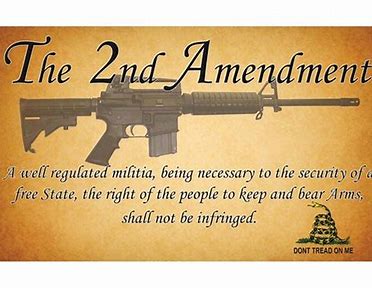
The Second Amendment is one of the first ten amendments to the Constitution, knows as the Bill of Rights, that was ratified in 1791.
Purpose
Was to provide a constitutional check on the federal government’s power to organize, arm and discipline the militia, and to ensure the people’s right to bear arms as a means of self-defense and resistance to tyranny. It was seen as a safeguard of freedom and liberty in America.
Right to Bear Arms
The text of the Second Amendment reads in full: “A well-regulated Militia, being necessary to the security of a free State, the right of the people to keep and bear Arms, shall not be infringed.”
The framers of the Bill or Rights adapted the wording of the amendment from nearly identical clauses in some of the original 13 state constitutions.
What is a Militia?
During the Revolutionary War era, “militia” referred to groups of men who banded together to protect their communities, towns, colonies and eventually states, once the United States declared its independence from Great Britain in 1776.
Many people in America at the time believed governments used soldiers to oppress the people and thought the federal government should only be allowed to raise armies (with full-time, paid soldiers) when facing foreign adversaries. For all other purposes, they believed, it should turn to part-time militias, or ordinary civilians using their own weapons.
But militias had proved insufficient against the British, the Constitutional Convention gave the new federal government the power to establish a standing army, even in peacetime.
Anti-Federalists
Were opponents of a strong central government. They argued that this federal army deprived states of their ability to defend themselves against oppression. They feared that Congress might abuse its constitutional power of “organizing, arming an disciplining the Militia” by failing to keep militiamen equipped with adequate arms.
So shortly, after the U.S. Constitution was officially ratified, James Madison proposed the Second Amendment as a way to empower these state militias. While the Second Amendment did not answer the broader Anti-Federalist concern that the federal government had too much power, it did establish the principle (held by both Federalists and their opponents) that the government did not have the authority to disarm citizens.
The Argument
Practically since its ratification, Americans have debated the meaning of the Second Amendment.
The basis being is whether the amendment protects the right of private individuals to keep and bear arms, or it instead protects a collective right that should be exercised only through formal militia units.
In Comes the Supreme Court
In its 5-4 decision in District of Columbia v. Heller, which invalidated a federal law barring nearly all civilians from possessing guns in the District of Columbia, the Supreme Court extended Second Amendment protection to individuals in federal (non-state) enclaves.
Writing the majority decision in that case, Justice Antonin Scalia lent the Court’s weight to the idea that the Second Amendment protects the right of the individual private gun ownership for self-defense purposes.
Be Safe Out There


